
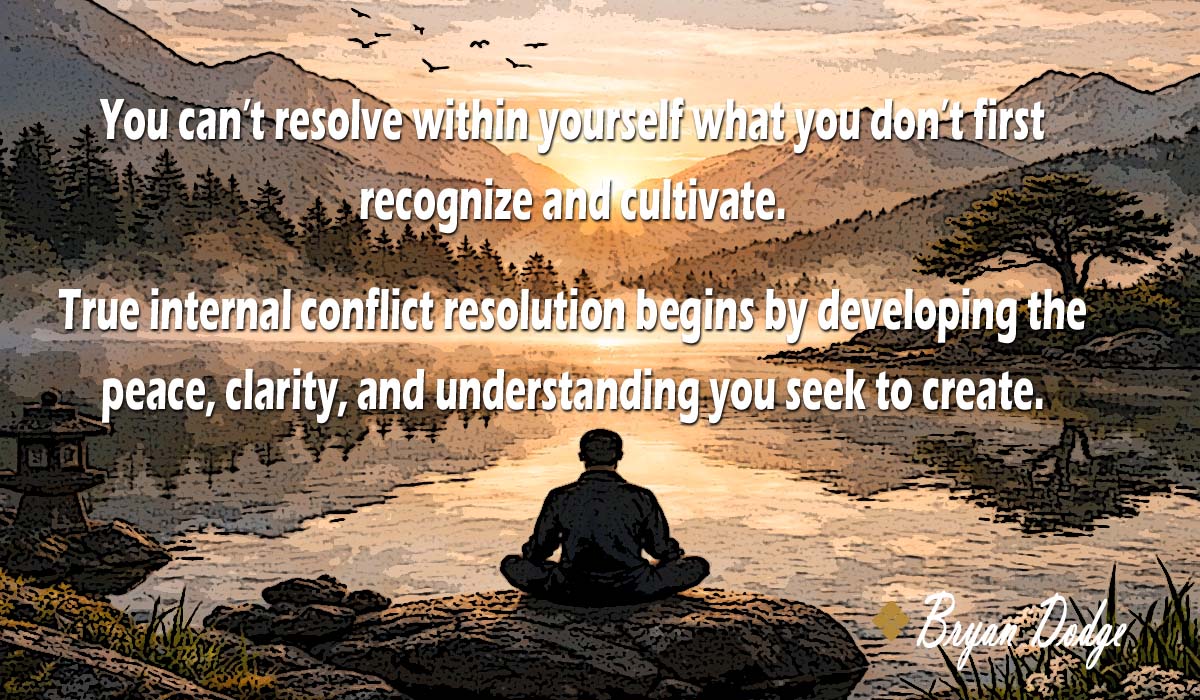
Every human being walks through life carrying on two conversations simultaneously. There’s the one happening out loud with other people, and there’s the quieter, more persistent one taking place inside our own minds. This internal dialogue rarely stops. It comments, judges, worries, plans, and reacts to everything we encounter throughout our days. Yet most people pay little attention to the quality of this inner voice or the profound impact it has on every aspect of their lives.
The conversations we have with ourselves are perhaps the most important discussions we’ll ever engage in, yet they’re also the ones we’re least likely to examine critically. These internal exchanges don’t just influence our mood or confidence—they fundamentally shape our relationships, our work, our parenting, and our ability to find meaning and satisfaction in life.
When we learn to resolve internal conflicts with wisdom and compassion, we discover something remarkable: the external conflicts in our lives begin to shift as well. The way we handle disagreements with our spouse changes. Our patience with our children expands. Our response to workplace stress becomes more measured. Our relationship with our own mistakes and shortcomings grows gentler.
The Nature of Internal Conversation
Most people would be shocked if they could listen to a recording of their internal dialogue throughout a typical day. The inner voice is often harsh, impatient, and filled with criticism that we would never direct toward someone we cared about. We tell ourselves we’re not good enough, smart enough, or capable enough. We rehearse past failures and project future disasters. We engage in endless mental arguments with people who aren’t even present.
This internal noise creates a constant state of low-level stress and dissatisfaction. When the voice in our head is dominated by fear, judgment, and negativity, it becomes nearly impossible to make decisions from a place of clarity and love. Instead, we find ourselves reacting from anxiety, protecting ourselves from imagined threats, and making choices that prioritize safety over growth.
Healthy internal conversation looks and feels entirely different. It acknowledges reality without dramatizing it. It recognizes mistakes without turning them into evidence of personal failure. It faces challenges with curiosity rather than dread. When we learn to speak to ourselves with the same kindness and wisdom we’d offer a dear friend, our entire experience of life begins to transform.
The shift doesn’t happen overnight, and it requires conscious effort. Most people have spent decades developing patterns of negative self-talk, and those patterns don’t dissolve simply because we recognize they’re unhelpful. Real change requires consistent practice in catching ourselves when we slip into harsh internal dialogue and gently redirecting our thoughts toward something more constructive and loving.
The Role of Love in Defining Good
When we examine what makes something truly good whether it’s a relationship, a career, a decision, or a life we discover that love must be present at its foundation. This isn’t the romantic, emotional love that dominates movies and songs, but something deeper and more substantial. It’s the love that chooses truth over comfort, growth over stagnation, and connection over self-protection.
Love, in this context, means caring enough to be honest. It means being willing to face difficult truths about ourselves and our situations rather than hiding behind excuses or blame. It means choosing to see other people as complex human beings rather than obstacles to our happiness or validation of our worth.
Without love at the core, even our best intentions become hollow. A parent who provides for their children financially but withholds emotional connection isn’t truly loving them. A leader who drives results but shows no care for the people achieving those results isn’t creating anything genuinely good. A person who pursues success while neglecting their relationships and inner life isn’t building a meaningful existence.
Love requires us to consider not just what we want, but what is truly needed. It asks us to look beyond our immediate desires and consider the long-term impact of our choices on ourselves and others. It demands that we take responsibility for our actions and their consequences rather than constantly seeking someone else to blame when things go wrong.
What Makes a Good Life
The question of what constitutes a good life has occupied philosophers, religious leaders, and thoughtful individuals for thousands of years. While the specific answers vary across cultures and time periods, certain themes consistently emerge. A good life involves meaningful relationships, purposeful work, personal growth, and the ability to contribute something positive to the world.
But these external markers of a good life are only possible when they’re supported by internal peace and clarity. A person who hasn’t learned to resolve their inner conflicts will struggle to maintain healthy relationships, no matter how much they want connection. They’ll find it difficult to engage in meaningful work because they’ll be constantly distracted by internal noise and anxiety. Personal growth will feel threatening rather than exciting because their internal dialogue tells them that change equals danger.
A good life requires the ability to be present with what is happening right now, rather than being constantly pulled into regrets about the past or worries about the future. It requires the capacity to make decisions based on values and love rather than fear and reactivity. It demands the courage to face difficult emotions and situations without immediately trying to escape or numb them.
Most importantly, a good life requires consistency between what we believe and how we actually live. Many people can articulate beautiful values and intentions, but when pressure comes, they abandon those principles in favor of whatever feels safe or easy in the moment. True goodness emerges when our actions align with our deepest convictions, even when it’s difficult or costly.
Love as the Foundation
Nothing in our lives becomes what it’s meant to be unless love is at its center. This principle applies to every area of human experience. Careers become fulfilling when they’re rooted in love—love for the work itself, love for the people it serves, or love for the growth it provides. Without love, even the most prestigious or lucrative career becomes a source of emptiness and burnout.
Families thrive when love is the foundation not just the feeling of love, but the daily choice to act with kindness, patience, and genuine care for each other’s wellbeing. Families that are held together only by obligation or habit eventually fracture under pressure. Those built on genuine love have the resilience to weather difficult seasons and emerge stronger.
Personal peace becomes possible when we learn to love ourselves in a healthy way not with narcissistic self-indulgence, but with the kind of compassionate honesty that allows for both acceptance and growth. Self-love means treating ourselves with the same kindness we’d show a good friend while still holding ourselves accountable for our choices and their impact on others.
Even our approach to challenges and failures changes when love is present. Instead of seeing difficulties as evidence that life is unfair or that we’re inadequate, we begin to view them as opportunities for growth and deeper understanding. Love gives us the courage to face hard truths and the patience to work through them constructively.
Living from Resolution
The way we resolve internal conflict quietly but powerfully shapes every choice we make. When we’ve learned to address our inner tensions with wisdom and love, we naturally begin making different decisions about how we spend our time, how we treat the people around us, and how we respond to unexpected challenges.
We choose patience over urgency because we’ve resolved the internal panic that makes everything feel like an emergency. We choose responsibility over blame because we’ve stopped seeing ourselves as victims of our circumstances. We choose alignment over exhaustion because we’ve learned to honor our deepest values rather than constantly trying to please everyone around us.
This doesn’t mean life becomes easy or that we stop facing difficult situations. It means we meet those situations from a place of internal stability rather than chaos. We respond rather than react. We choose rather than simply follow old patterns of behavior.
The life we ultimately live is nothing more than the outward expression of the internal conflicts we’ve either resolved or continue to ignore. When we do the hard work of creating peace within ourselves, that peace naturally extends into every aspect of our existence, creating the foundation for relationships, work, and personal fulfillment that truly reflect our deepest values and aspirations.

Comments are closed