In today’s rapidly evolving business environment, many organizations focus heavily on growth, sales, technology, and profitability while overlooking one of the most important foundations of long-term success: organizational structure and clearly defined operational roles. Without a well-developed structure supported by clearly written job descriptions, task accountability, compensation standards, and leadership development pathways, even highly talented teams can struggle with inefficiency, confusion, communication breakdowns, inconsistent performance, and limited scalability.
A successful organization is not built solely on good ideas or hardworking employees. It is built on clarity, accountability, structure, and leadership. Businesses that establish strong operational systems create environments where employees understand their responsibilities, leadership operates effectively, communication improves, and long-term growth becomes sustainable.
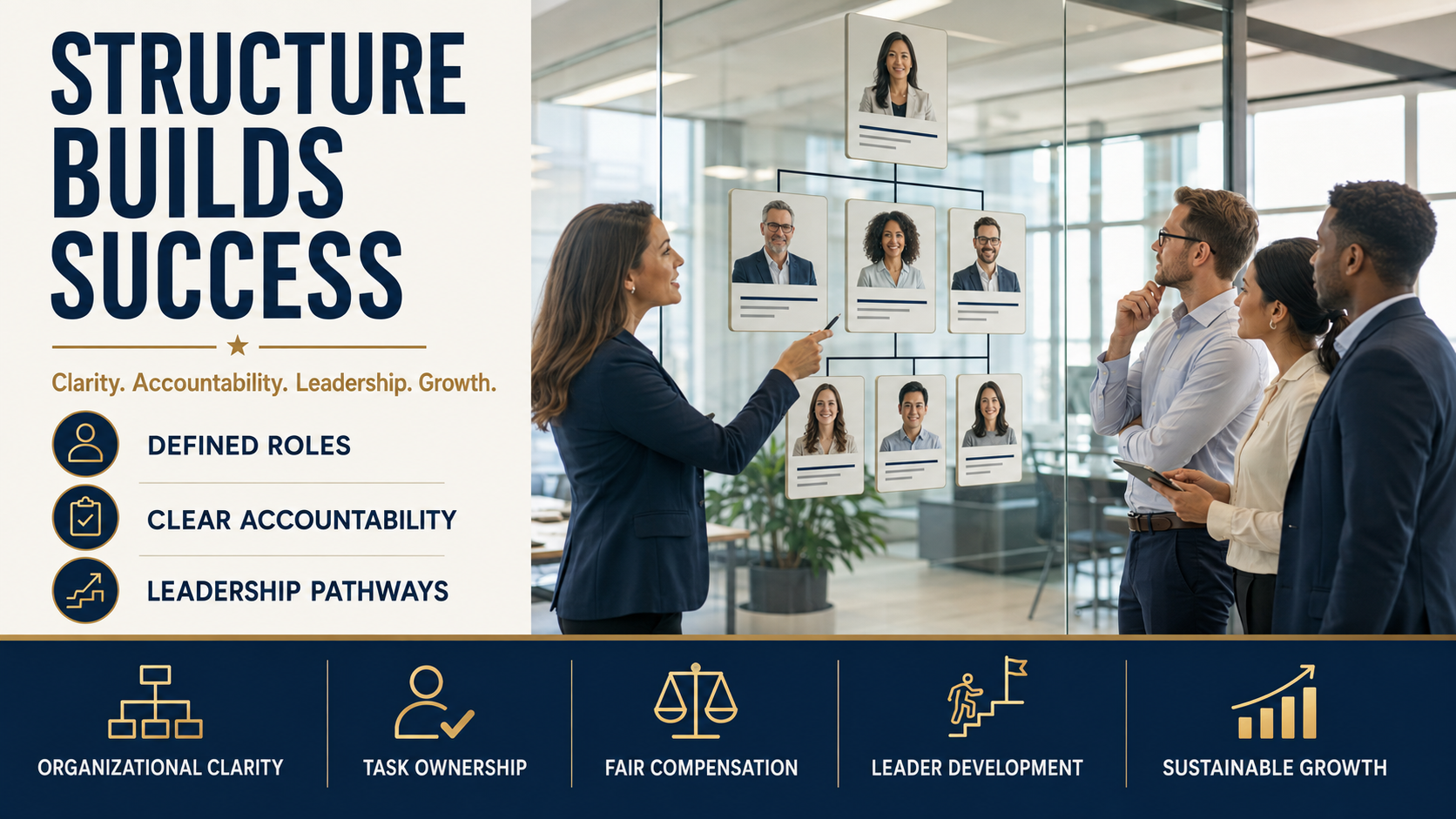
Organizational structure serves as the operational framework of a company. It defines reporting relationships, communication channels, departmental responsibilities, leadership hierarchy, and accountability systems. More importantly, it helps ensure that every critical activity within the organization is properly assigned, managed, and measured.
Without a clearly defined structure, businesses often encounter duplicated responsibilities, operational gaps, unclear authority, inconsistent processes, and employee frustration. Departments may unintentionally overlap efforts while other essential functions are neglected altogether. Over time, this creates inefficiency, slows productivity, weakens accountability, and places unnecessary strain on leadership.
One of the greatest advantages of a properly developed organizational structure is clarity. Employees perform more effectively when they understand their role, their responsibilities, who they report to, and how their position contributes to the organization’s overall mission. Clear structure removes uncertainty and allows employees to focus on productivity rather than internal confusion.
Equally important are clearly written job descriptions and detailed task lists. Job descriptions should go far beyond a simple title and a few vague responsibilities. They should provide a complete understanding of the role, including operational duties, leadership expectations, reporting relationships, measurable performance standards, required qualifications, compensation ranges, and long-term development opportunities.
Detailed task lists help ensure that every activity within the company is accounted for and assigned appropriately. They create consistency across departments while reducing confusion regarding ownership and responsibility. This allows organizations to identify operational inefficiencies, balance workloads, and ensure that no critical responsibilities are overlooked.
Clearly defined roles also improve accountability throughout the organization. When expectations are vague, it becomes difficult to fairly evaluate performance or identify the source of operational issues. Employees may become frustrated due to inconsistent expectations, while leadership struggles to determine whether problems stem from inadequate training, poor communication, or undefined responsibilities. Well-developed job descriptions establish measurable standards that create fairness, transparency, and operational consistency.
In addition to responsibilities and task accountability, strong job descriptions should also define the qualifications, experience, technical abilities, certifications, and leadership competencies required for each position. This helps organizations establish objective hiring standards while ensuring that employees fully understand what is necessary to succeed within their role.
Perhaps even more valuable is the ability to use job descriptions as career development tools. Organizations that outline the training, mentoring, certifications, operational experience, and leadership skills required to advance into higher-level positions create a clear pathway for employee growth. Rather than leaving advancement opportunities undefined, businesses establish structured development systems that motivate employees and strengthen long-term retention.
Employees are more engaged when they can clearly see how to progress within the organization. They gain confidence knowing there is a defined path toward increased responsibility, leadership opportunities, and professional growth. This not only improves morale but also strengthens succession planning by helping companies identify and develop future leaders before critical operational needs arise.
Salary ranges and compensation structures also play a critical role in organizational stability and employee trust. Many companies struggle with internal conflict because compensation standards evolve inconsistently over time or become emotionally driven rather than strategically developed. Standardized salary ranges based on responsibility level, required skill sets, leadership expectations, workload, and organizational value help create fairness and consistency throughout the organization.
By evaluating positions strategically, companies can better understand the true value of each role while ensuring compensation aligns appropriately with operational responsibilities. This creates stronger employee confidence, improves hiring practices, and supports long-term workforce planning.
At Dodge Development, Inc., organizational development goes far beyond traditional business consulting. Dodge Development works closely with organizations to evaluate operational structures, leadership systems, departmental workflows, communication processes, and employee responsibilities in order to build stronger, more efficient, and highly effective organizations.
Through comprehensive organizational analysis, Dodge Development assists companies in developing customized organizational structures, detailed job descriptions, task accountability systems, salary frameworks, reporting relationships, leadership development pathways, and operational standards tailored specifically to each organization’s goals and culture.
The process often includes leadership assessments, employee feedback analysis, workflow evaluations, department reviews, organizational chart development, and operational planning. Dodge Development helps businesses identify inefficiencies, uncover gaps in responsibility, improve communication systems, and create accountability structures that support long-term operational success.
What makes Dodge Development unique is its integration of business operations with leadership coaching, communication analysis, and human behavior understanding. Every position within an organization represents more than a title or task list — it represents a person with strengths, communication styles, leadership potential, and professional development opportunities. By aligning organizational structure with employee capabilities and leadership development, companies are able to maximize both efficiency and effectiveness throughout the organization.
In today’s competitive business environment, organizations can no longer afford to operate without clearly defined structures, responsibilities, expectations, and development systems. Businesses that invest in organizational clarity position themselves for stronger communication, higher productivity, improved accountability, better leadership development, greater employee retention, and sustainable long-term growth.
A company becomes more efficient when every responsibility is clearly assigned. It becomes more effective when every employee understands their role and expectations. And it becomes stronger when structure, leadership, accountability, and employee development work together as a unified system designed for long-term success.

Comments are closed